The Roman Theatre in Lecce
The vibrant center of the historic city of Lecce in Puglia is home to a wide selection of beautiful buildings, culture, and art. One of the most beautiful of these is the Roman Theatre. Unfortunately, many tourists miss the opportunity to visit because it is tucked between the buildings of the city and to find it, you must first know where it is.
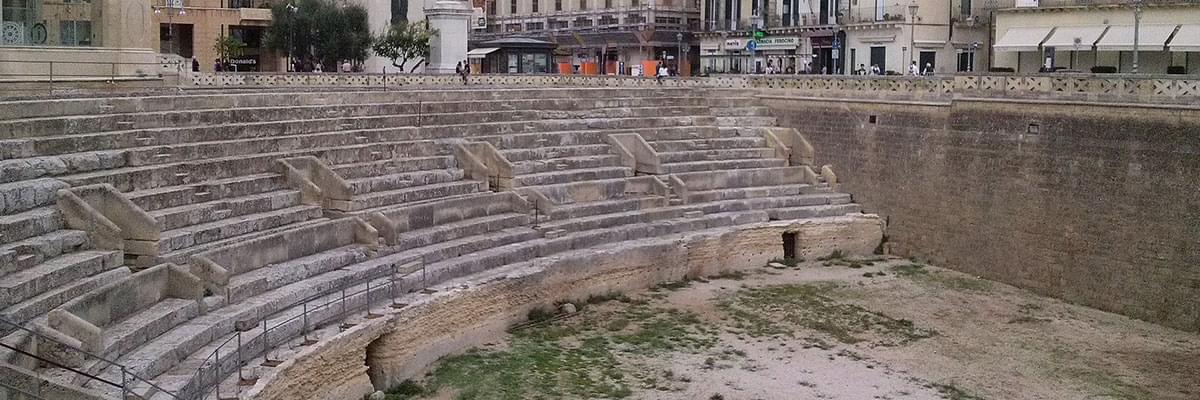
The Roman Theatre is just a stone’s throw away from the Duomo and the Piazza Sant’Oronzo and was discovered by accident during an excavation to restructure a building in 1929. At first, the stone steps of the theatre were revealed, and after more work, the rest of the structure was uncovered. Statues that once decorated the theatre were also retrieved, with many dating back to the times of Antonini. The statues themselves were discovered to be late additions as, after more research, historians asserted that the theatre would have been built between the first and second centuries during Hadrian’s reign as the Roman Emperor. At this time, Lecce would have been barely more than a small village used as a simple trading port along the Mediterranean.
There is some debate as to how many people the theatre once held, with estimates ranging from 5,000 to 25,000 Today, it could only hold a fraction of that amount as the majority of the theatre is covered over by other buildings in the centre of Lecce, including the Church of Santa Maria della Grazia. Some parts of the theatre wall have been uncovered, however, and many are coated with ancient images that depict the types of shows that would have been held in the theatre.
The main types of entertainment held in the theatre would have included comedies, tragedies, and gladiator fights. Many performances would involve the hunting of exotic animals brought to Puglia from the fringes of the Roman Empire and fights between prisoners sentenced to death. Each day would have a set schedule, with animal fights occurring in the morning, public executions at lunchtime, and gladiator fights in the afternoon.
To learn more about the theatre’s history, you can visit the local museum in Via Degli Ammirati which recounts the story of its discovery, the artefacts found during excavations, and the general history of the theatre. Some notable pieces showcased at the museum are theatre masks from Villa Adriana in Tivoli and a plastic reconstruction of the city of Lecce in the Imperial age.
Today, the theatre hosts several events, including sporting celebrations (particularly when the local team of U.S. Lecce wins matches, live music events, and a nativity scene is held there during winter.
If you would like to find the theatre, here is a quick guide:
Begin in the small square near the Church of Santa Chiara, nearby Piazza Sant’Oronzo and opposite Via Theutra. From there, you can locate Via Arte della Cartapesta, which is the main street leading to the theatre. This is one of the only ways you can access the Roman Theatre and many of the other roads are inaccessible to the public.
.jpg)

.jpg)

.jpg)
.jpg)

.jpg)
.jpg)
.jpg)
.jpg)