Castello di Ugento
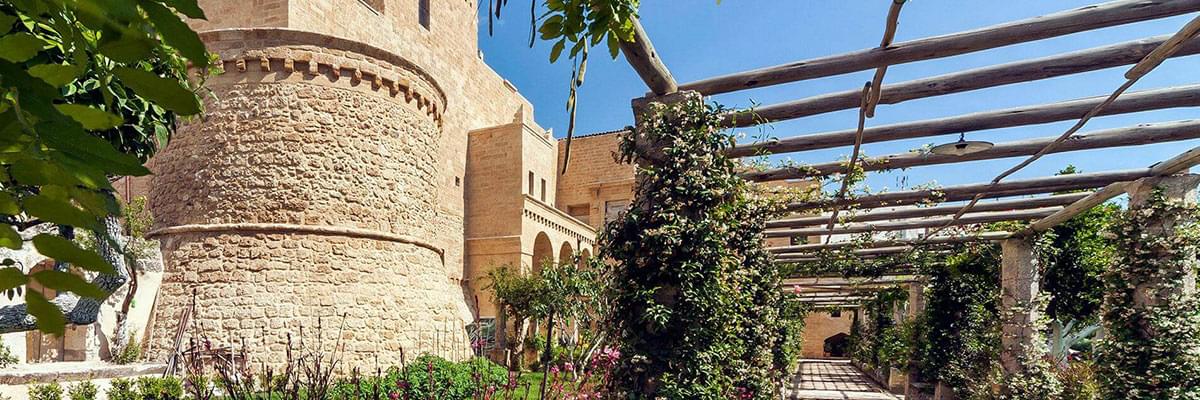
One of the most magnificent castles in the Otranto region is Castello di Ugento. The castle, perched on a hill, dominated and guarded the countryside and settlement underneath it. It was presumably erected during the Roman era on Messapian ruins. The circular tower was first built as a motte and bailey structure and dates to the Normans, who took control of the area in 1059. All those who have seen the Bayeux Tapestry in Normandy will be familiar with the recognisable mound and tower.
The village of Ugento and its fief were purchased in 1643 by Don Pietro Giacomo d'Amore. Over 375 years later, the family is still the legal owners of Castello di Ugento. The d'Amore family coat of arms features a pelican against a golden backdrop exposing its breast with its beak and feeding its young with its own heart, the ultimate expression of love, as an ode to their name, which means "of love."
When there was a war, the castle was destroyed, rebuilt, expanded, and altered. But it has a far longer history. The Normans, who erected the tower that was discovered after being hidden for 900 years, constructed it in the 12th century. In contrast, the 18th century saw the creation of the walled garden, or "giardino di piante utili." Over the years, the once-elegant Baroque house has deteriorated. Puglia saw peace and prosperity in the 16th and 17th centuries, and local landowners transformed their castles into opulent mansions. The Baroque style was introduced to Salento by wealthy families traveling between Naples and their southern estates.
Now that baroque was fashionable, it had a significant impact on the field of art and architecture. It was more than just a decorative style, though; it included all forms of artistic expression and served as the impetus for a period of reconstruction that changed the neighborhood's architectural landscape.
At the height of the Baroque era, in 1643, when Pietro Giacomo d'Amore purchased Castello di Ugento, patronage of the arts had come to represent a nobleman's riches, influence, and status. The effort to revitalize the castle through renovation and restoration got under way in 2013. Large stone slabs dating to the 8th century BC that were attributed to the Messapians were also found beneath the restaurant during the reconstruction. Meanwhile, Bronze Age artifacts discovered during the architectural work date to the 12th century BC. The evidence also suggests that there were inhabitants here as early as the Hellenistic era, around the third century BC.
The meticulous restoration effort has removed layer after layer, revealing fresh evidence that has helped reconstruct the dramatic and interesting history of Castello di Ugento. This majestic stronghold will celebrate its illustrious past with tours of its mythical sequence of frescoes after the ground-breaking restoration and reconstruction project, but it will also look to the future by fostering the artistic talent of the area. A stunning modern exhibition space will be housed amid the vast Baroque first floor apartments' soaring Salentine star-shaped vaults. Artists and photographers from Italy and around the world will present their work in front of a stunning golden stone backdrop.
In conclusion, Castello di Ugento is a significant representation of the rich history of the Apulia area of Italy and an amazing example of medieval construction. The castle has endured a long history of military strife and political upheaval, but it still stands as a tribute to the cunning and talent of medieval builders and architects. Castello di Ugento is a must-see location for anybody traveling through southern Italy, regardless of your interest in history, architecture, or simply seeking a fascinating and lovely spot to visit.
.jpg)

.jpg)
.jpg)
.jpg)
.jpg)

.jpg)
.jpg)
.jpg)